
What's the Difference Between Furniture and Fitted Joinery?
What's the Difference Between Furniture and Fitted Joinery?
The confusion is common, and understandable. These two practices (along with carpentry) share the same materials, the same machines, sometimes the same gestures. Yet they are two distinct specialities, each complete and complex in its own way. Neither is more noble or more difficult than the other. They simply answer different needs.
Two Relationships to the Building
What fundamentally distinguishes these practices is their relationship to space and to the building itself.
Fitted joinery is fixed to the building. Kitchens, walk-in closets, bathrooms, built-in storage. In short, everything designed to optimise a specific space and that stays in place when you move out. The joiner works mainly with engineered wood panels and hardware systems that allow for precise, repeatable production. It's a coordination trade, often working directly with architects and project managers.
Furniture, on the other hand, accompanies its owner. A table, an armchair, a wardrobe, an object, pieces with a life of their own, independent of the space they happen to be in. They get taken along, handed down. Contrary to popular belief, furniture isn't necessarily made of solid wood. It can be veneer, panel, solid wood, or a combination of the three, depending on the project, the desired aesthetic and the budget, and sometimes paired with other materials such as stone, metal or fabric. What defines it is the attention paid to design, detail, joinery and durability. To better understand the wood species I use in the workshop, I invite you to read How to choose the right wood species for custom furniture.
Then there's carpentry, a cousin discipline. It occupies another territory, that of the building envelope itself. Windows, doors, shutters, gates, flooring (even though flooring installation is its own trade too), all the elements that make up a building's shell. It's a third trade, often confused with the first two, but which follows its own logic.
This distinction also has a concrete legal translation. A fitted-joinery specialist or carpenter, as soon as their work is attached to the building, is subject to the ten-year structural warranty required under France's 1978 Spinetta law: the work must be covered for ten years against damage affecting the building's soundness or use. A cabinetmaker who builds standalone furniture has no such obligation, since the pieces aren't fixed to the structure. It's a detail often overlooked by the public, but one that says a lot about the real nature of each trade.
Repairability and Legacy
Furniture, because it lives independently of the building, can go through several lives. A solid wood piece can be repaired, resanded, given a new patina each time. It changes owners, homes, sometimes generations, without ever losing its function. Fitted joinery, on the other hand, follows the fate of the building. When a kitchen is redone or a house is sold, built-in elements either stay or get torn out with the renovation, rarely dismantled to be reused elsewhere. That difference in fate is also a difference in impact: a piece of furniture built to last and be passed down slows the constant turnover of furnishings, while fitted joinery, however well made, remains tied to the life cycle of the building that houses it.
What Ties These Trades Together
All three practices share common ground. Woodworking machines are found in every workshop. Materials overlap too, from solid wood to panels to veneer. That shared ground is exactly what creates confusion in a client's mind. And it's also what makes these trades porous in practice.
I've personally worked in framing, carpentry, fitted joinery and cabinetmaking before focusing, under the name Quentin Delion, on custom furniture and object design in the Basque Country. That range of practice feeds each speciality, but it doesn't make them interchangeable.
The Bookcase, a Borderline Object
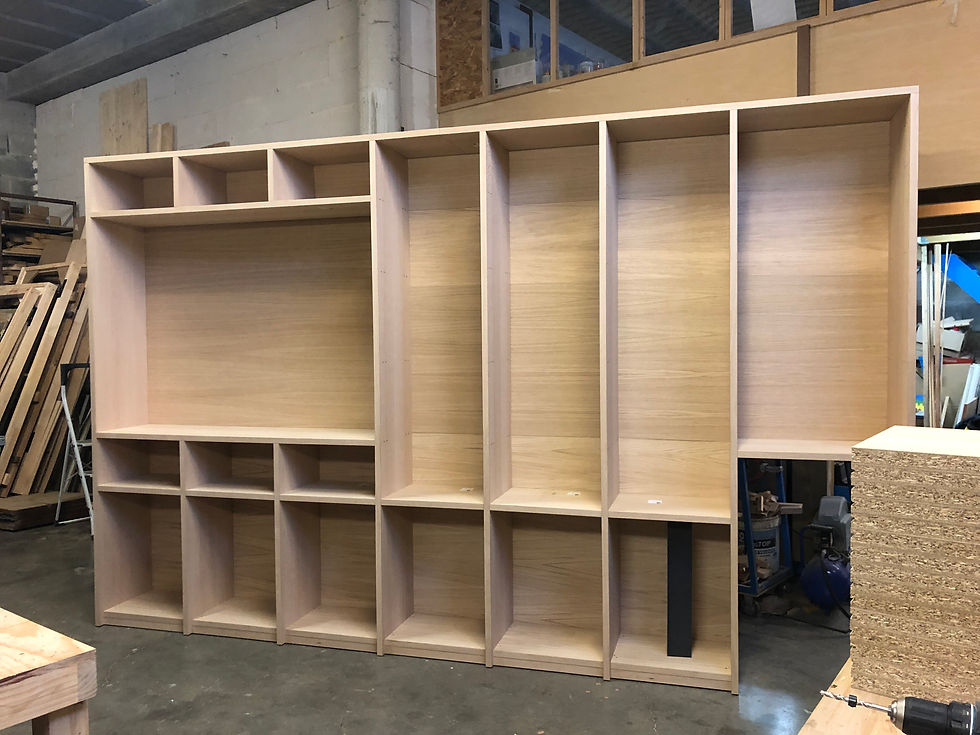
The bookcase is the perfect example of the line between furniture and fitted joinery. It can be designed as a standalone piece, set against a wall, that you take with you when you move. Or as fitted joinery, fixed to the building, built into the architecture of the room. Same object, two approaches, two trades. That's exactly where my own line sits between the two practices, and it's often through discussing the project that we work out together which approach fits best. That's the kind of conversation described in How a custom project unfolds.
Each Trade Is Its Own Speciality
What matters to remember is that each of these practices takes years to master. The confusion between them doesn't diminish their complexity. A good fitted-joinery specialist isn't a failed cabinetmaker. A carpenter isn't an incomplete joiner. These are full-fledged specialities, each with its own logic, its own constraints and its own standards.
Frequently Asked Questions
Can a fitted-joinery specialist make furniture? Technically yes, they have the skills. What can be missing isn't the technical know-how but the culture specific to cabinetmaking: the history of styles, proportions, and certain joints that keep a piece of furniture standing the test of time, traditional joinery techniques that are almost never used in fitted work.
Does a cabinetmaker need the ten-year structural warranty to build furniture? No. That warranty only applies to work attached to a building. A standalone piece of furniture, whoever makes it, falls outside that scope.
Do custom furniture and fitted joinery always compete with each other? No, they're often combined in the same project. The distinction isn't a hierarchy, it's a choice of logic depending on whether a piece needs to stay attached to the space or live independently.
Is custom furniture more eco-friendly than fitted joinery? Not by nature, but often by fate. A piece of furniture can be repaired, resold, passed down, independently of the building it was made for, while fitted joinery generally follows the fate of the renovation or the sale of the property. Longevity and repairability matter as much as material choice in a real environmental assessment.
Quentin Delion is a designer and cabinetmaker based in Bidart, in the Basque Country, designing and building contemporary custom furniture in wood, pieces made to last, independent of the space they end up in.
Have a custom furniture project in the Basque Country? Let's talk.
Library here in furniture mode

Tv furniture with fitted joinery

Library


Glass partition and kitchen island, fitted joinery

PALO library

Crédit photo : Papi aime Mamie


Comments